Fiducial beads
Fiducial beads are bright, stable markers put on a sample to follow its drift: their positions over a movie are the
drift, which an SMLM analysis then subtracts. inSiliScope can put beads on any sample (the cell field and the
nanorulers), with a type, a density, a size, a height and a share of clumps. They are off by default (density 0).
Turn them on with the viewer's Fiducial beads group (Sample section), Micro-Manager's Fiducials device, or the
CLI's --fid-* options (below). The beads belong to the sample: they drift with it, and the CLI's <movie>.drift.csv
is their ground truth. The bead sample is the beads alone, on a bare coverslip (below).
Bead types
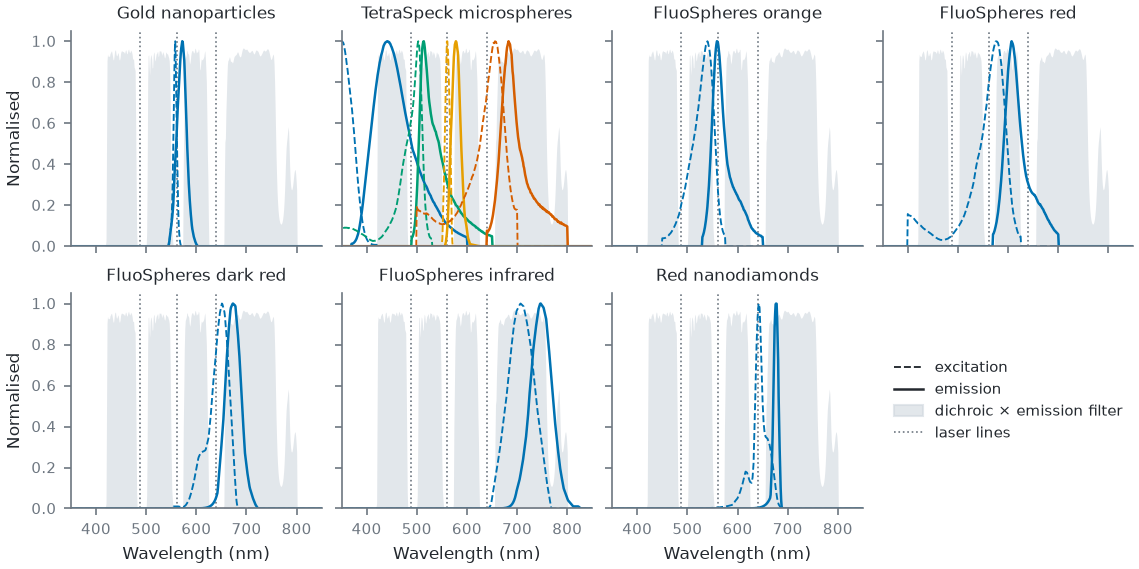
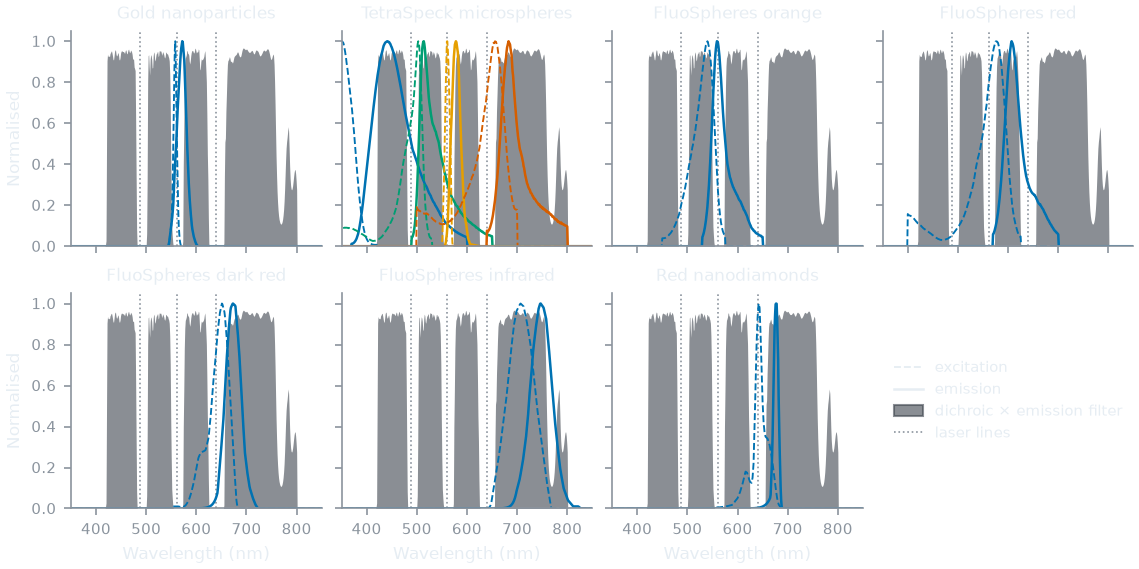
Spectra and brightness follow Balinovic, Albrecht and Endesfelder 2019, who compared these markers for SMLM
[balinovic2019]. Where the paper has no spectrum, the spectra come from FPbase
[lambert2019] and the nominal maxima from the manufacturer
[thermofisher_fluospheres]. The data are in data/fiducials/
(README).
Type (Type, --fid-type) |
Size | Colours (ex/em, nm) | Bleaches | Notes |
|---|---|---|---|---|
Gold (the default type) |
100 nm | photoluminescence ~560/575 | no | also scatters every laser line (Mie); the filters' blocking floor decides how much reaches the camera |
TetraSpeck |
100 nm | 360/430, 505/515, 560/580, 660/680 | yes, each dye on its own | one bead in four channels |
FluoSpheresOrange |
200 nm | 540/560 | yes | a marker that also shows in a 488 nm channel |
FluoSpheresRed |
200 nm | 580/605 | yes | |
FluoSpheresDarkRed |
200 nm | 660/680 | yes | very bright under 640 nm: can saturate a camera at SMLM powers |
FluoSpheresInfrared |
100 nm | 715/755 | yes | red-shifted, for imaging next to a 640 nm channel |
Nanodiamond |
100 nm | NV centres, ~640/680 | no |
| Type | Component | PSF λ (nm) | Equiv. dyes | Detected (photons/s) | Detected share | Half-time |
|---|---|---|---|---|---|---|
| Gold nanoparticles (100 nm) | photoluminescence | 580 | 2.53 | 73035 | 32 % | never |
| scattered 488 nm | 488 | – | 502 | – | never | |
| scattered 561 nm | 561 | – | 2670 | – | never | |
| scattered 640 nm | 640 | – | 1809 | – | never | |
| TetraSpeck microspheres (100 nm, 4 colours) | blue dye (360/430) | 468 | 705 | 0 | 54 % | – |
| green dye (505/515) | 536 | 705 | 4.0×10⁷ | 67 % | 8.4 min | |
| orange dye (560/580) | 584 | 705 | 6.6×10⁷ | 60 % | 4.9 min | |
| dark red dye (660/680) | 698 | 705 | 8.0×10⁷ | 73 % | 5.9 min | |
| FluoSpheres orange (200 nm, 540/560) | orange dye (540/560) | 581 | 1.00×10⁵ | 2.8×10⁹ | 38 % | 11 min |
| FluoSpheres red (200 nm, 580/605) | red dye (580/605) | 615 | 1.00×10⁵ | 8.7×10⁹ | 65 % | 6.1 min |
| FluoSpheres dark red (200 nm, 660/680) | dark red dye (660/680) | 677 | 1.00×10⁵ | 1.1×10¹⁰ | 72 % | 6.3 min |
| FluoSpheres infrared (100 nm, 715/755) | infrared dye (715/755) | 740 | 1.00×10⁵ | 1.1×10⁷ | 58 % | 90 h |
| Red nanodiamonds (100 nm) | NV centres | 676 | 1.93×10⁵ | 2.8×10¹⁰ | 83 % | never |
How this figure was made (7 cli runs, 52 ms)
Generated by tools/build_physics_figures.py (figure fid-spectra) from the code it documents at commit 72b1b0f, on Linux with 4 threads, 2026-11-01. Commands, in order, with their wall time (those marked [served] ran one after the other in one insiliscope_cli --serve process, which keeps the world and the PSF kernel between commands; their outputs are the same as separate runs'):
insiliscope_cli --setup-json Gold.setup.json --npc-dye Cy3B --laser-488 1 --size 32 --frames 1 --fid-type Gold --prepare 1    # 9.6 ms [served]
insiliscope_cli --setup-json TetraSpeck.setup.json --npc-dye Cy3B --laser-488 1 --size 32 --frames 1 --fid-type TetraSpeck --prepare 1    # 7.6 ms [served]
insiliscope_cli --setup-json FluoSpheresOrange.setup.json --npc-dye Cy3B --laser-488 1 --size 32 --frames 1 --fid-type FluoSpheresOrange --prepare 1    # 7.4 ms [served]
insiliscope_cli --setup-json FluoSpheresRed.setup.json --npc-dye Cy3B --laser-488 1 --size 32 --frames 1 --fid-type FluoSpheresRed --prepare 1    # 7.1 ms [served]
insiliscope_cli --setup-json FluoSpheresDarkRed.setup.json --npc-dye Cy3B --laser-488 1 --size 32 --frames 1 --fid-type FluoSpheresDarkRed --prepare 1    # 6.9 ms [served]
insiliscope_cli --setup-json FluoSpheresInfrared.setup.json --npc-dye Cy3B --laser-488 1 --size 32 --frames 1 --fid-type FluoSpheresInfrared --prepare 1    # 7.0 ms [served]
insiliscope_cli --setup-json Nanodiamond.setup.json --npc-dye Cy3B --laser-488 1 --size 32 --frames 1 --fid-type Nanodiamond --prepare 1    # 7.0 ms [served]
The size in the table is the product size, which picking a type sets as the DiameterNm (below); any other size
keeps the type's spectra. The brightness of each dye is an equivalent dye count (dyes with ε = 10⁵ M⁻¹ cm⁻¹ and QY
0.5) at the type's product size, scaling with the bead's volume (d³). For gold, TetraSpeck and the nanodiamonds it was fitted to the
paper's counts: each bead's brightest pixel against single dyes (mEos3.2, JF646) in the same images. The FluoSpheres
are set to 100 000 equivalent dyes (an estimate) in place of the paper's fits (41 000 for the dark red, 4 × 10⁶
for the infrared, whose far tails the paper's curves underestimate). The fits stay
in data/fiducials/types.json as emitters; emittersSet overrides them. The spectral losses stay in the light path,
not in the count. A dark-red bead under a 561 nm line behind a 595/50 filter, for example, keeps about 10⁻⁵ of its
light, which is why beads of hundreds to tens of thousands of equivalent dyes are usable next to single molecules. The
nanodiamonds' calibration also comes out unphysically high, for the same reason as the infrared beads'. A 20 nm bead
of a type has its dyes scaled with the volume: (20/100)³ of TetraSpeck's, about 6 per colour, (20/200)³ of the
FluoSpheres', 100 (an estimate); 20 nm beads are about as bright as a few to a hundred single dyes. Set DyeCount
(Expert, --fid-dyes) to override every component's count.
Placement, size and height
- Positions are random, with no minimum distance: a Poisson field of
DensityPerUm2beads per µm² of coverslip (--fid-density), so doublets and clusters happen as on a real coverslip. The positions are a pure function of the seed and the place, like every other part of the sample. - Size:
DiameterNm(Advanced, Basic on the bead sample in the viewer,--fid-diameter-nm): picking a type sets its product size (100 or 200 nm), and any size can be set after it, such as 20 nm beads (the CLI's −1, its default, is the type's size). The dyes scale with the volume. The bead-to-bead spread isDiameterCvPct(12 %, an estimate within the 10-15 % typical of these products). - Height (
Height, Basic,--fid-height):Coverslip: the bead's centre one radius above the glass, also under the cells (the beads go down first).OnTop(default): on the sample's highest surface there (the cytoplasm or nucleus of a cell; the bare glass between cells), centre one radius above it. Not offered on the bead sample, where it is the glass: mounting it movesOnTopbeads toCoverslip.Layer: anywhere in a gel layer (e.g. agarose) ofLayerUm(10 µm; Advanced, Basic on the bead sample in the viewer) between the coverslip and the layer's top, outside the cells.
| On the coverslip | On top of the sample | In a 10 µm gel layer |
|---|---|---|
 |
 |
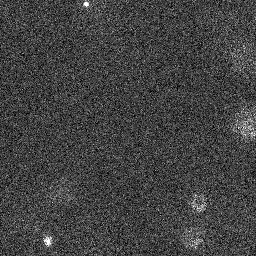 |
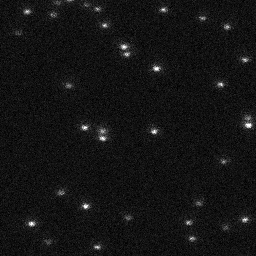
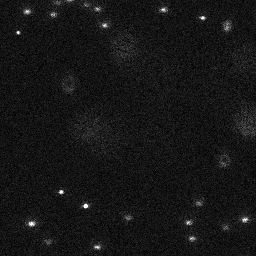
The same 25.6 µm field of the cell field (256 px of 100 nm, one 50 ms frame, focus 0.5 µm above the coverslip, no labels: only the beads emit) with TetraSpeck beads at 0.05 per µm² (made dim here, 2 equivalent dyes, so none saturates), at the three heights: on the glass (sharp at this focus, also under the cells), on the sample's highest surface (the cells' tops several µm above the focus: wide rings, the bare glass between them sharp) and anywhere in a 10 µm gel outside the cells (most far out of focus).
How this figure was made (3 cli runs, 4.73 s)
Generated by tools/build_physics_figures.py (figure fid-heights) from the code it documents at commit 72b1b0f, on Linux with 4 threads, 2026-11-01. Commands, in order, with their wall time (those marked [served] ran one after the other in one insiliscope_cli --serve process, which keeps the world and the PSF kernel between commands; their outputs are the same as separate runs'):
insiliscope_cli --out h0.movie.tif --x 6.58 --y -5.61 --size 256 --frames 1 --mt-dye None --npc-dye None --laser-561 1 --laser-640 0 --fid-type TetraSpeck --fid-dyes 2 --fid-density 0.05 --fid-height 0    # 4.17 s [served]
insiliscope_cli --out h1.movie.tif --x 6.58 --y -5.61 --size 256 --frames 1 --mt-dye None --npc-dye None --laser-561 1 --laser-640 0 --fid-type TetraSpeck --fid-dyes 2 --fid-density 0.05 --fid-height 1    # 289 ms [served]
insiliscope_cli --out h2.movie.tif --x 6.58 --y -5.61 --size 256 --frames 1 --mt-dye None --npc-dye None --laser-561 1 --laser-640 0 --fid-type TetraSpeck --fid-dyes 2 --fid-density 0.05 --fid-height 2    # 269 ms [served]
Clumps
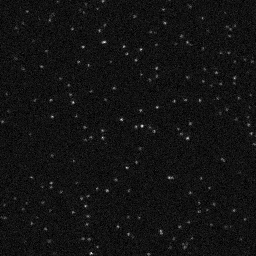
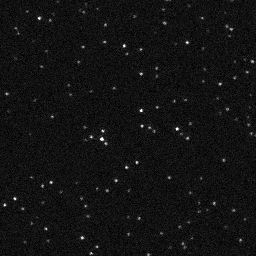
Beads in a suspension stick together, so a coverslip has single beads, pairs and larger clumps. One setting,
AggregationPct (Basic, --fid-aggregation-pct, 0 to 90 %, default 0; 40 % on the bead sample), is the chance p that a bead is stuck to the
next one. A clump then holds n beads with probability (1 − p) pⁿ⁻¹: a geometric spread of sizes, mean 1 / (1 −
p), which is the size distribution of colloids that stick at a constant rate (Smoluchowski coagulation with a
constant kernel; the model is an estimate, not fitted to any bead product). At 10 %, 81 % of the beads are single,
most of the rest in pairs; at 50 % a clump holds two beads on average. The density counts beads, so clumps make fewer
and brighter spots. Each bead of a clump touches one placed before it, chosen at random, without overlapping the
others: in the coverslip plane on the coverslip and on top of the sample (each at its own height there), in 3D in a
gel layer. A clump stays within 2 µm of its first bead and holds at most 64 beads.
| Aggregation 0 % | 30 % | 70 % |
|---|---|---|
 |
 |
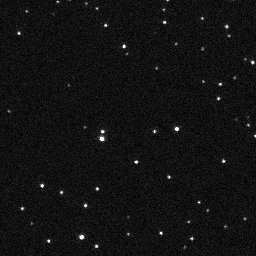 |
The bead sample at its defaults (a bare coverslip, 100 nm gold at 0.3 beads per µm², 561 nm at 0.1 kW/cm², focus on the beads' centres) but the aggregation, one 50 ms frame of 256 px of 100 nm, one contrast for all three. The density counts beads, so the more stick together, the fewer and brighter the spots: at 30 % half the beads are in clumps (mean 1.4 beads), at 70 % nearly all (mean 3.3); a clump is far smaller than the PSF, so it looks like one brighter bead.
How this figure was made (3 cli runs, 8.91 s)
Generated by tools/build_physics_figures.py (figure fid-clumps) from the code it documents at commit 72b1b0f, on Linux with 4 threads, 2026-11-01. Commands, in order, with their wall time (those marked [served] ran one after the other in one insiliscope_cli --serve process, which keeps the world and the PSF kernel between commands; their outputs are the same as separate runs'):
insiliscope_cli --out a0.movie.tif --x 6.58 --y -5.61 --size 256 --frames 1 --specimen Beads --fid-aggregation-pct 0    # 8.78 s [served]
insiliscope_cli --out a30.movie.tif --x 6.58 --y -5.61 --size 256 --frames 1 --specimen Beads --fid-aggregation-pct 30    # 75 ms [served]
insiliscope_cli --out a70.movie.tif --x 6.58 --y -5.61 --size 256 --frames 1 --specimen Beads --fid-aggregation-pct 70    # 64 ms [served]
The bead sample
Bead sample (Beads) is a sample of its own: a bare coverslip with only the fiducial beads, for a PSF or drift
calibration, or to look at the beads alone. It has no targets to label: every setting is the Fiducial beads one.
Mounting it while no beads are set (density 0) puts 0.3 beads per µm² down, and while the aggregation is 0 sets it
to 40 % (the CLI: when --fid-density or --fid-aggregation-pct is not given). Its light is the 561 nm line at
0.1 kW/cm², the other lasers off, through the 561 nm widefield filters (the light preset Beads-561, the automatic
preset on this sample, which has no labels for one to follow). The viewer shows the diameter and the gel layer's
thickness at Basic here (Micro-Manager creates its properties at one level when the hub starts, so they stay
Advanced there). The CLI focuses on the beads' centre when --z is not given (a radius above the glass; the layer's
middle in a gel layer).
The image of a bead
A bead is not a point: a 200 nm sphere holds dyes over its whole volume. Its image is the PSF averaged over the solid
sphere (in z over 10 nm slabs, laterally over its projection), which matters within about a micrometre of the centre
and near the focus (where the PSF is not much wider than the bead; off focus the sphere changes it by under 1 % and the
point PSF is used). Outside that the bead's halo is the point PSF. A clump is drawn as one bead of the clump's volume
(a pair of 100 nm beads as one 126 nm bead) at its centre of mass with all its beads' light; Renderer.Quality
Exhaustive (or Renderer.BeadClumpsAsOne Off, Expert; --fid-clumps-as-one 0) draws each bead. A touching pair is
longer than that sphere, which shows only for large beads in focus; one splat per clump makes a clumpy sample's frames
up to twice as fast. Each bead is one emitter per colour, never 10⁶ dyes. Beads do not
blink.
A bead is far brighter than a dye, and above or below the focus its light spreads into a disc several micrometres
wide (about 2.4 µm of radius per µm of defocus at NA 1.4). So its halo is not cut at the PSF window the dyes use
(±3 µm in the viewer, ±7 µm in Micro-Manager): it comes from a second PSF window twice the field of view (at most
±30 µm), sampled once per camera pixel, and reaches as far as the bead gives at least 0.1 photon per pixel. In z the
beads have a PSF stack of their own, 14 µm (PsfZRangeUm, Advanced, --fid-psf-z-range-um; the dyes' stack is
the objective's 7 µm; the dyes are cut at CellField.ZRangeUm, ±3.5 µm, the beads are not), so a bead on top of a
cell or in a gel layer far from the focus keeps its defocused image instead of vanishing. Beyond the stack (more than
7 µm off focus) a bead is drawn as a blur that grows with the defocus: a Gaussian with all its light, as wide at the
stack's edge as the last plane (its second moment) and wider in proportion to the defocus, faded in over the stack's
last 0.5 µm, so the bead fades smoothly with no step. This is an approximation (not the defocused PSF's shape).
FarDefocus (Expert, --fid-far-defocus 0) leaves such beads out instead: faster with many beads far off focus,
whose blurs reach tens of µm. That stack's oversampled point window is at most ±3 µm wide (the halo takes the light
beyond it): over 14 µm, Micro-Manager's ±7 µm window would take about 1.2 GB per bead colour. A bright or
defocused bead lights the whole frame. Costs: the wide window takes ~0.5 s per colour once (256 px), and the beads take
a few per cent of a movie, about 15 % in a drifting one, where every bead is drawn again in every frame.
Bleaching
The dyes in a bead bleach one by one, but there are so many that the bead's signal decays smoothly:
exp(−t ln 2 / t½). BleachHalfTimeSec (Expert, --fid-bleach-half-sec, 288 s, an estimate) is the
half-time at BleachRefKWcm2 (1 kW/cm², --fid-bleach-ref-kwcm2) at the dye's own excitation peak. The bleach rate
follows the excitation rate, so a bead bleaches more slowly at less light and off its peak: TetraSpeck's dark-red dye
under 561 nm fades about 10 times more slowly than at its peak at the same intensity. Gold and nanodiamonds do not bleach.
In Micro-Manager the beads fade with the sample's illumination history, like every dye: a bead that was lit stays
dimmer after a pause, a move away and back, or a change of a bead setting (which keeps the history). CLI and viewer
movies start at --start-sec under the movie's own light.
Gold's scattered laser light
Gold nanoparticles scatter the excitation light elastically (Mie scattering; gold's optical constants from Johnson
and Christy [johnson1972], the method of Bohren and Huffman
[bohren1983]). Ideal filters would block it fully, so the emission path is given a
blocking floor: every laser line passes the dichroic and the emission filter at least at 10⁻ᴼᴰ (BlockingOD, Expert,
--fid-blocking-od, 8: a dichroic ~OD 2 times an emission filter ~OD 6, an estimate). The floor applies to the
scattered light only; the dyes' light path is unchanged.
Settings
| Viewer (Sample > Fiducial beads) | Micro-Manager (Fiducials) |
CLI | Default |
|---|---|---|---|
| Density | DensityPerUm2 (Basic) |
--fid-density |
0 (off) |
| Type | Type (Basic) |
--fid-type |
Gold |
| Diameter, Diameter spread | DiameterNm, DiameterCvPct (Advanced) |
--fid-diameter-nm, --fid-diameter-cv-pct |
the type's size, 12 % |
| Height | Height (Basic) |
--fid-height |
OnTop (the bead sample: Coverslip) |
| Layer thickness | LayerUm (Advanced) |
--fid-layer-um |
10 µm |
| Aggregation | AggregationPct (Basic) |
--fid-aggregation-pct |
0 % (the bead sample: 40 %) |
| PSF z range | PsfZRangeUm (Advanced) |
--fid-psf-z-range-um |
14 µm |
| Beyond the PSF stack | FarDefocus (Expert) |
--fid-far-defocus |
On (a growing blur; Off: not drawn) |
| Bleach half-time, Reference intensity | BleachHalfTimeSec, BleachRefKWcm2 (Expert) |
--fid-bleach-half-sec, --fid-bleach-ref-kwcm2 |
288 s, 1 kW/cm² |
| Equivalent dyes | DyeCount (Expert) |
--fid-dyes |
−1 (the type's) |
| Filter blocking | BlockingOD (Expert) |
--fid-blocking-od |
8 |
The viewer draws the beads in the world view and in its x-z side view as discs of their diameter (the Fiducial beads checkbox, View).
Not modelled: blinking of bead aggregates (their light is the sum of their beads'), single-dye bleaching steps, and the beads' BrightField contrast.